How to respond to an s56 request for information
· 11 min read
A notice headed "Request for more information" and citing section 56 of the Migration Act 1958 (Cth) is not a refusal. It means a delegate wants more information before deciding a visa application. For a registered migration agent, the work is to read every item, diary the correct deadline, collect what was asked for, respond in the specified way, and keep a proper client file. This guide reflects the law as at November 2026.
Two different "section 56" provisions come up here. Do not mix them up:
- Section 56 of the Migration Act — the Minister may seek further information about a visa application. That is the request this article is about.
- Section 56 of the Migration (Migration Agents Code of Conduct) Regulations 2021 — your duty to create and keep a client file, generally for seven years after the last action on that file.
What an s56 request is
Section 56 sits in Subdivision AB of the Act, the code of procedure for visa applications. Under subsection 56(1), the Minister may get any information considered relevant and, if that information is obtained, must have regard to it when deciding whether to grant or refuse the visa. Under subsection 56(2), the Minister may invite the applicant, orally or in writing, to give additional information in a specified way.
Agents call that invitation an s56 request or a request for further information. It may ask for a police certificate, updated employment evidence, a missing form, an explanation of inconsistent dates, or extra relationship or financial documents. It is a request for more material while the application is still on foot, not a finding that the visa will be refused.
How the request is given
The invitation may be oral or written, and it must specify how the additional information is to be given. Section 58 covers both s56 invitations and section 57 invitations to comment. It must say whether the information or comments may be given in writing, at an interview with an officer, or by telephone. If it is not an interview, section 58(2) requires a response within the period specified in the invitation: a prescribed period or, if none is prescribed, a reasonable period.
For online applications, the Department of Home Affairs says further information must be uploaded to ImmiAccount. Its visa guidance says to check ImmiAccount regularly for requests and to respond quickly; if you cannot provide what was asked for, explain why using the contact details in the correspondence; do not email documents; and keep your own copies, because supporting documents cannot be accessed from ImmiAccount after they are uploaded.
Do not assume the clock starts when someone opens the notice. If the Minister gives a document by a method in section 494B, the person is taken to have received it at the time set by section 494C. Regulation 2.15 notes this expressly. In practice:
- A document handed over under section 494B(2) or (3) is taken to be received when it is handed over.
- Prepaid post sent under section 494B(4) from Australia to an Australian address is taken to be received 7 working days (in the place of that address) after the date of the document; otherwise, 21 days after that date.
- Fax, email or other electronic means, sent to the last number or address provided for receiving documents, is taken to be received at the end of the day it is transmitted (section 494C(5)).
- A document made available through an online account of the recipient, established for purposes relating to the Act or the regulations, is taken to be received at the end of the day it is made available (sections 494B(5A) and 494C(6)).
ImmiAccount is an online account of that kind. A request made available there under section 494B(5A) is taken to have been received at the end of that day, whether or not anyone opened it. Check the due date in the invitation against the deadline calculated using the applicable deemed-receipt rule. If those deadlines differ, use the earlier one for planning.
If the applicant has appointed an authorised recipient under section 494D — usually the agent — the Minister must generally give documents about those matters to the authorised recipient instead of the applicant, and is then taken to have given the document to the applicant. For clients who have appointed you as their authorised recipient, work from the deemed-receipt date that applies to you.
How long you have to respond
Start with the period specified in the invitation. That is the period that applies under section 58(2). Regulation 2.15 sets the prescribed periods, subject to regulation 2.15(2):
| Situation | Prescribed period |
|---|---|
| Application for a substantive visa by an applicant in immigration detention | 5 days after the applicant is notified of the invitation |
| Applicant in Australia (except the detention case above); invitation given at an interview | 7 days after the interview |
| Applicant in Australia (except the detention case above); invitation given in a telephone conversation | 7 days after the invitation is given |
| Applicant in Australia (except the detention case above); written invitation; Subclass 600 (Visitor) or Medical Treatment (Visitor) (Class UB) visa | 7 days after the applicant is notified |
| Applicant in Australia (except the detention case above); written invitation; any other case | 28 days after the applicant is notified |
| Application for a Visitor (Class TV) visa, which is the Subclass 651 (eVisitor) visa | 7 days after notification, or 70 days if the Minister so decides in the circumstances of the case |
Regulation 2.15(1) does not prescribe a period for most other applicants outside Australia. Section 58(2) then requires a reasonable period specified in the invitation, so use the response deadline in the invitation.
Those prescribed periods do not apply to a request for information or comments to be obtained from a third party about the applicant's health, public interest criteria, English language capacity, or skills or qualifications (regulation 2.15(2)). If the invitation is to attend an interview, regulation 2.15(3) sets separate times. For an applicant outside Australia, that interview period is 28 days after notification, or 70 days if the Minister so decides.
Section 58(4) allows the Minister to extend a prescribed period by a prescribed further period. Regulation 2.15(4) sets that further period at 5 days in detention; 7 days if the applicant is in Australia but not in detention; and, if the applicant is outside Australia, 7 days, or 28 days if the Minister so decides. An extension is not automatic. Ask before the current period ends, using the contact details in the correspondence, and explain why.
What happens if the time passes
If the information is not given in time, section 62(1) allows the Minister to grant or refuse the visa without taking any action to obtain it. Section 62(2) is the matching rule for an invitation to comment.
The Department is not required to refuse, and it is not required to wait. After inviting the applicant to give information, section 63(2) says the Minister is not to refuse before the first of these happens: the information is given; the applicant says they do not wish to give it or do not have it; or the time for giving it ends. After that, a decision can be made on what is already on the file.
Section 65 then requires the Minister to grant the visa if satisfied the relevant criteria and other requirements are met, and to refuse it if not so satisfied. Missing material can leave the delegate not satisfied of a criterion.
Until a decision is made, section 55 still lets the applicant give additional relevant information, and the Minister must have regard to it. The Minister need not delay a decision because further information might still arrive (section 55(2)). Late relevant material that actually arrives before a decision must be considered. You cannot rely on the Department waiting for it.
How an s57 letter is different
Section 57 deals with certain adverse information, not a routine request for extra documents. In that section, "relevant information" means information (other than non-disclosable information) that the Minister considers would be the reason, or part of the reason, for refusing the visa; is specifically about the applicant or another person, not merely about a class of persons; and was not given by the applicant for the application.
Where that applies, the Minister must give the applicant particulars of the information, ensure as far as reasonably practicable that the applicant understands why it is relevant, and invite comment. Agents often call this a natural justice letter. It uses the same section 58 rules for how and when to respond. If a notice puts information meeting that definition and invites comment, treat it as engaging section 57, even if it also asks for documents under section 56.
A practical workflow
- Open the notice the day it appears. Do not wait for the client to mention an unread email.
- Record the document date, the date it was made available or transmitted, the due date in the invitation, and every item requested.
- Work out the deadline from the invitation and from sections 494B and 494C. Diary an internal buffer well before that date.
- Write to the client the same day with an itemised list, in language they can read. If you speak with them, make a contemporaneous written record (Code of Conduct section 55).
- Collect documents through a channel that leaves a file, not a personal WeChat or WhatsApp thread. Review each item against the request. If something cannot be obtained in time, say so before the deadline and explain why.
- Respond in the specified way. For most online applications, upload to ImmiAccount against the request. Documents not in English must be translated into English; translators in Australia must be NAATI-accredited; submit both the original and the translation.
- Keep your own copy of what was uploaded, with evidence of when it was submitted, on the client file.
Record-keeping under the Code of Conduct
Section 56 of the Code is a different duty from section 56 of the Act. You must create and maintain a client file. It must include a copy of the application or other immigration matter; copies of all service agreements and variations; all written communications (including electronic communications) with the client and with any other person or organisation about the client; contemporaneous records of oral communications with the client; records of material oral communications with other people about the client; invoices and receipts; copies of personal documents provided by or on behalf of the client; and evidence that original documents were safely returned.
The file may be written, electronic, or both. You must take all reasonable steps to keep it for seven years after the last action on the file for that client, and give OMARA access to a file held by you or your business if it requests access in writing for the purposes specified in section 56(9). Section 53 separately requires client documents to be kept securely. For an s56 request, keep the notice, your working list, collection messages, uploads, proof of submission and phone notes on that file — not only in a personal inbox.
Checklist
- Read the whole notice and list every item
- Confirm whether it is an s56 request, an s57 invitation to comment, or both
- Record the document date, the date it was given or made available, and the due date stated
- Apply the section 494C deemed-receipt rule that matches the method of giving
- Diary the deadline and an earlier internal buffer
- Write to the client the same day with an itemised list
- Record any oral advice or instructions contemporaneously
- Collect and review each document against the request, and arrange translations where required
- If something cannot be obtained in time, contact the Department before the deadline
- Upload the response in the specified way, usually via ImmiAccount
- Keep copies and proof of submission on the client file
How Immiluma can help
Immiluma keeps each s56 request on the matter, from the day it arrives to the day you respond, so it never lives only in a spreadsheet or a personal chat thread.
You can record an s56 request on the matter. An open s56 stays at the top of the Today list until the response is sent, alongside client questions, documents to review and upcoming dates. Each matter can move to a "Further info requested" stage, and the ImmiAccount transaction reference number (TRN) stays on the matter.

Clients open a link to the portal and upload from their phone, including photographing a document so it becomes a multi-page PDF. You see what is still missing, review each file beside the requirement it is meant to meet, and can send a document back with a reason the client can read. The portal works in English, Simplified Chinese, Japanese and Korean.
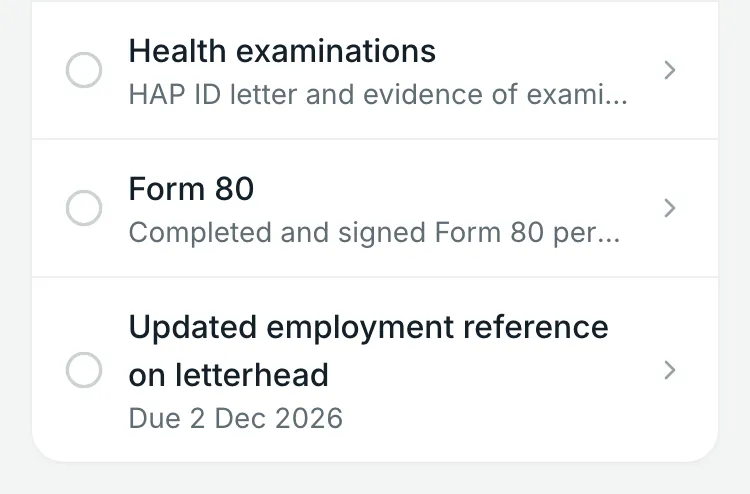
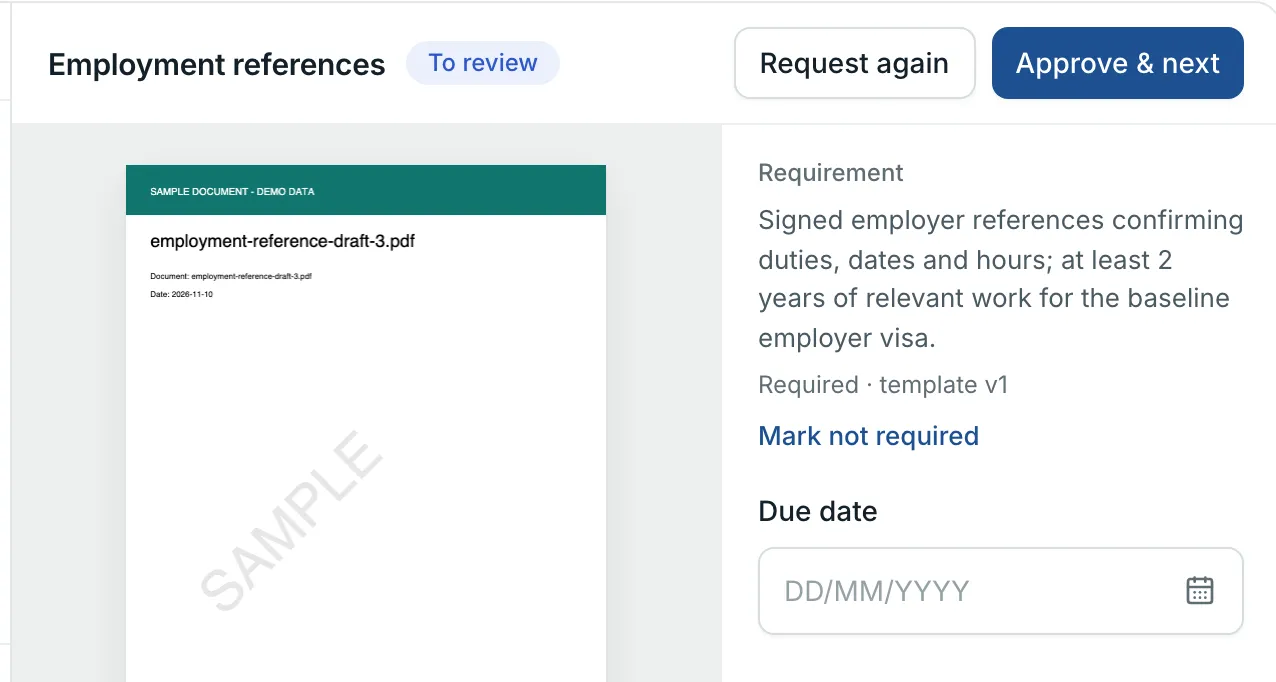
When everything is ready, download the documents as one lodgement pack and upload them in ImmiAccount. Messages, uploads and activity stay on the client's timeline.
Disclaimer
This article is general information for registered migration agents and immigration lawyers. It is not legal advice, and it is not a substitute for reading the notice in front of you or the law in force on the day you act. Always check the current compilation on the Federal Register of Legislation and the wording of each invitation. Response times and notification rules can change. Immiluma is not affiliated with or endorsed by the Department of Home Affairs or OMARA.
Updates
- — First published